

Sleep product development has traditionally been ingredient-driven.
A brand chooses melatonin for sleep onset, GABA for relaxation, magnesium for nervous system support, or a botanical ingredient for stress management. Each ingredient has its own scientific background and market positioning.
But sleep itself is more complex than any single ingredient.
For product developers looking at the next generation of sleep supplements, the more useful question may no longer be “Which sleep ingredient should we use?”
It may be:
“Which aspects of sleep health should the formulation address, and how can different ingredients work together?”
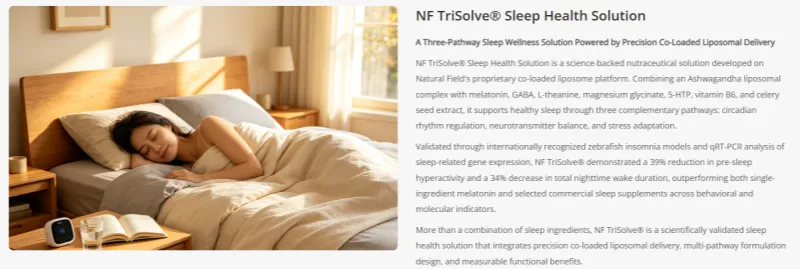
Different sleep ingredients are associated with different physiological functions.
Melatonin is closely connected with the body's circadian rhythm and sleep timing. GABA is involved in inhibitory neurotransmission and has been investigated for sleep onset and relaxation. L-theanine has attracted attention for relaxation and stress management, while magnesium plays a role in nervous system function and has been studied in relation to sleep.
Ashwagandha, meanwhile, is being investigated for its potential role in stress adaptation and related sleep outcomes.These ingredients are not interchangeable.
A product built around only one of them may have a clear positioning, but it may not address the multiple factors that influence the sleep experience.
This is where a pathway-based formulation approach becomes relevant.
Instead of starting with a list of ingredients, formulators can start by identifying the functional pathways they want a product to address.
For sleep health, three complementary areas are particularly relevant:
Pathway 1 — Circadian Rhythm Support Melatonin
Sleep timing is closely connected to the circadian rhythm. Melatonin provides a biological signal associated with the onset of the body's nighttime phase and is therefore commonly used in products targeting sleep timing and sleep onset.
For formulators, however, the question extends beyond simply adding melatonin. Dose, timing, release profile, and delivery format can all influence its pharmacokinetic behavior.
Pathway 2 — Neurotransmitter Balance GABA + L-Theanine + Magnesium Glycinate
The transition from wakefulness to sleep also involves changes in nervous system activity.
GABA contributes to inhibitory neurotransmission, while L-theanine is studied for its relaxation and stress-related effects. Magnesium is involved in neuronal function and several pathways relevant to nervous system regulation.
Combining these ingredients provides a formulation framework for supporting relaxation and reducing excessive neural arousal.
The objective is not to claim that the three ingredients have identical functions. Instead, they can be considered complementary components within the same formulation pathway.
Pathway 3 — Stress Adaptation Ashwagandha
Stress is another important consideration in modern sleep product development.
Ashwagandha is an adaptogenic botanical that has been studied in relation to stress, anxiety, and sleep-related outcomes. Its role within a sleep formulation is therefore different from that of melatonin or GABA.
Rather than directly targeting sleep timing, Ashwagandha can be positioned within a broader stress-adaptation pathway.
This distinction is important when building a formulation: different ingredients can have different jobs.
A multi-ingredient formula is not automatically a better formula.
Simply adding more ingredients can create challenges around dosage, compatibility, sensory properties, manufacturing, cost, and regulatory positioning.
The value of a multi-pathway approach lies in purposeful formulation design.
Instead of asking:
“How many sleep ingredients can we put into one product?”
the more useful question is:
“Does each ingredient have a clear role within the overall formulation?”
This approach can also make product development more systematic.
A formulation might begin with the desired functional outcomes, map those outcomes to relevant pathways, and then select ingredients based on their individual evidence, compatibility, dosage requirements, and delivery characteristics.
Once multiple functional ingredients are selected, another question becomes important:
How should these ingredients be delivered?
This is particularly relevant when botanical actives and other functional ingredients have different physicochemical characteristics, stability requirements, or absorption profiles.
Delivery technology can therefore become part of the formulation strategy rather than an isolated technical feature.
For example, controlled-release and prolonged-release melatonin formulations have demonstrated that changing the delivery profile can alter melatonin exposure over time. Research into advanced melatonin delivery systems is also expanding, although many newer technologies remain at the preclinical or development stage.
For commercial product development, this means that delivery technology should be evaluated alongside ingredient selection, formulation compatibility, manufacturing feasibility, and evidence.
This is the formulation concept behind NF TriSolve® Sleep Health Solution.
Rather than presenting sleep as a single-ingredient problem, NF TriSolve® organizes the formulation around three complementary pathways:
Pathway 1 — Circadian Rhythm Support
Melatonin
Pathway 2 — Neurotransmitter Balance
GABA, L-theanine, and magnesium glycinate
Pathway 3 — Stress Adaptation
Ashwagandha
The system combines these functional ingredients into a structured sleep formulation rather than treating each ingredient as an independent solution.
The formulation also incorporates Natural Field's co-loaded liposomal delivery technology, with Ashwagandha and melatonin co-encapsulated within the liposomal system.
This creates two layers of formulation design:
Functional layer: Multiple ingredients addressing complementary sleep-related pathways.
Delivery layer: A co-loaded liposomal system designed to support the delivery of selected active ingredients.
For brands, the value of this approach goes beyond a single finished product.
A pathway-based formulation framework can provide a starting point for developing different dosage forms, ingredient combinations, and product concepts according to market positioning and target consumer needs.
It also gives product developers a clearer way to communicate the scientific rationale behind a formulation.
Instead of presenting a long ingredient list, a brand can explain:
What is the product designed to support?
Which pathways does it address?
Why were these ingredients selected?
How does the delivery technology support the formulation?
This creates a more coherent product story—from scientific rationale to formulation design and commercial positioning.
The next generation of sleep products may not be defined by a single “hero ingredient.”
Instead, innovation is increasingly about how ingredients are selected, combined, and delivered as part of a coherent formulation strategy.
Melatonin, GABA, magnesium glycinate, L-theanine, and Ashwagandha each bring different functional considerations to sleep product development. The opportunity lies in understanding those differences and using them deliberately.
NF TriSolve® Sleep Health Solution brings this concept together through a three-pathway formulation framework supported by co-loaded liposomal delivery technology.
From individual ingredients to biological pathways, and from formulation design to delivery technology, the goal is to give brands a more structured approach to developing the next generation of sleep health products.
1. Hepsomali P, Groeger JA, Nishihira J, Scholey A. Effects of Oral Gamma-Aminobutyric Acid (GABA) Administration on Stress and Sleep in Humans: A Systematic Review. Frontiers in Neuroscience. 2020.
2. Schuster J, et al. Magnesium Bisglycinate Supplementation in Healthy Adults Reporting Poor Sleep: A Randomized, Placebo-Controlled Trial. Nature and Science of Sleep. 2025.
3. Bulman A, et al. The Effects of L-Theanine Consumption on Sleep Outcomes: A Systematic Review and Meta-Analysis. Sleep Medicine Reviews. 2025.
4. Cotter J, et al. Examining the Effect of L-Theanine on Sleep: A Systematic Review of Dietary Supplementation Trials. Nutritional Neuroscience. 2026.
5. Li Y, et al. Optimizing the Time and Dose of Melatonin as a Sleep-Promoting Drug: A Systematic Review of Randomized Controlled Trials and Dose-Response Meta-Analysis. Journal of Pineal Research. 2024.
6. Anderson KN, et al. Pharmacokinetics of Exogenous Melatonin in Relation to Formulation, and Effects on Sleep: A Systematic Review. Sleep Medicine Reviews. 2021.

Professor and Ph.D. Supervisor, School of Pharmaceutical Sciences, Southern Medical University. Head of the Functional Ingredient R&D Center, Natural Field. Professor Chong Li is a distinguished researcher in the field of advanced drug delivery systems and pharmaceutical technology innovation.


 EN
EN
 es
es  jp
jp  ko
ko  fr
fr  de
de  it
it  ru
ru  pt
pt  th
th  ar
ar  ms
ms