
Recently, the research team from Shanghai University of Traditional Chinese Medicine has recently revealed for the first time in a latest research paper published online in the international journal Advanced Science: Apigenin, a dietary flavonoid compound, can inhibit the abnormal activation of the senescence-associated secretory phenotype (SASP) by targeting the Peroxiredoxin 6-calcium-independent phospholipase A2 (PRDX6-iPLA2) axis. This, in turn, delays the progression of various aging-related diseases and provides a new direction for aging intervention.
Image source: Advanced
A Detailed Explanation of the Scientific Mechanism To explore the anti-aging potential of natural products, the research team conducted a large-scale screening of a natural product library containing 66 natural products. Eventually, they found that apigenin exhibits significant "senomorphic" activity (activity that regulates senescent secretory processes).
This characteristic is distinctly different from that of existing anti-aging compounds—such as ABT-737 and Procyanidin C1 (PCC1), which work by inducing senescent cell apoptosis. The core mechanism of apigenin lies in its selective inhibition of the senescence-associated secretory phenotype (SASP), thereby reducing the triggering factors of aging-related diseases at the source.
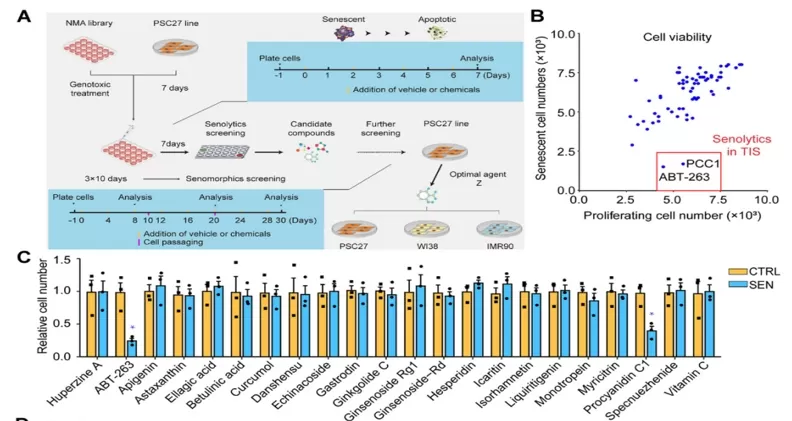
Image source: Advanced
Further research revealed that the intracellular molecule HSPA8 serves as a key "hub" for regulating aging-related stress responses. Apigenin can effectively block the conversion of the acute stress-associated phenotype (ASAP) to SASP by inhibiting the interaction between the ATM/p38MAPK signaling pathway and HSPA8, thereby breaking the "stress-aging" transmission chain.
By means of techniques such as biotin-labeled probes and drug affinity target stability (DATS), the team also identified the core target of apigenin’s action: peroxiredoxin PRDX6. Specifically, apigenin can precisely bind to the Cys91 and Glu210 sites of PRDX6, and specifically inhibit its calcium-independent phospholipase A2 (iPLA2) activity (with no impact on its peroxidase activity). Subsequent experiments confirmed that: when the PRDX6 gene is knocked down or its inhibitor MJ33 is used, the same SASP-inhibiting effect as apigenin can be simulated, verifying that PRDX6 is the key "target switch" for apigenin to exert its anti-aging effect.
Animal experiments further confirmed the anti-aging value of apigenin: after administering apigenin intervention to prematurely aging mice, the mice’s aging-related symptoms were significantly improved—not only did their fur condition and alveolar structure return to normal, but their muscle strength, hanging endurance, and balance ability were also significantly enhanced. More notably, aging-induced neurodegenerative issues in mice, such as cognitive impairment, were also effectively prevented by apigenin. This indicates that apigenin can minimize the pathological damage caused by aging by inhibiting SASP expression.
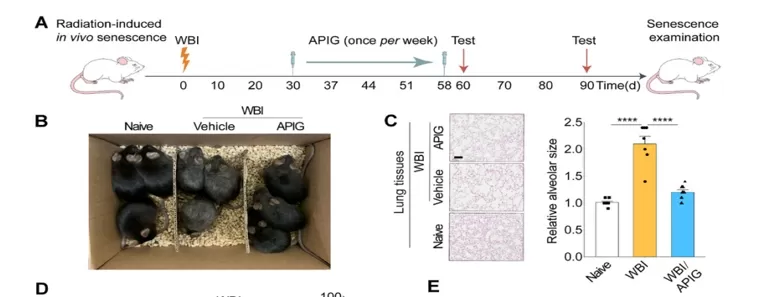
Image source: Advanced
Apigenin is a dietary flavonoid widely present in natural food ingredients. It derived its name from being first isolated from celery, and is also found in high concentrations in parsley, chamomile, grapes, citrus fruits, and a variety of medicinal plants.
In terms of physicochemical properties, apigenin has low water solubility but high permeability, allowing it to easily penetrate the plasma membrane of cells. At the same time, it possesses lipophilicity, enabling it to remain stable in the low-acid environment of the human gastrointestinal tract—providing basic conditions for it to exert biological activity.
With multiple biological activities such as antioxidant, anti-inflammatory, and neuroprotective effects, apigenin has become a research hotspot in the fields of nutrition, pharmacology, and medicine in recent years, and its potential in health maintenance continues to be explored.
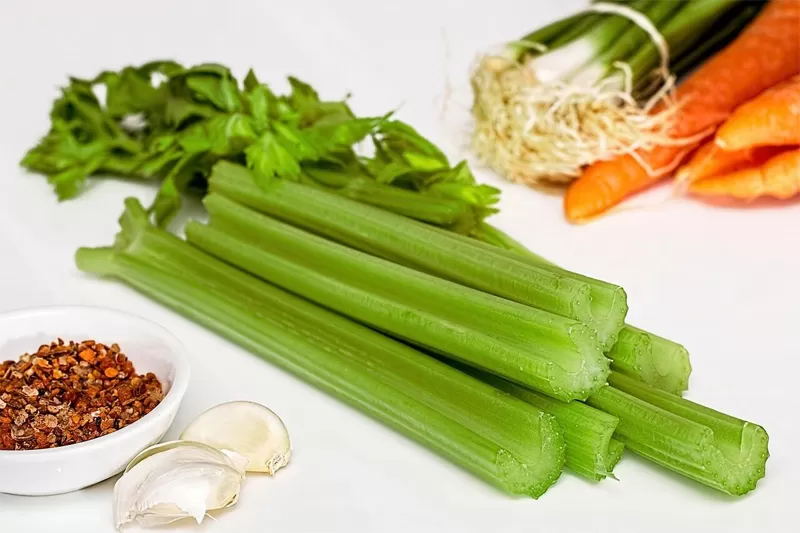
Image source: Pixabay
1. Cardiovascular Protection: Reducing Disease Risk
Apigenin can lower the risk of cardiovascular diseases by improving vascular endothelial function, regulating blood lipid levels, and inhibiting the formation of atherosclerotic plaques. Mouse experiments have shown that supplementation with apigenin significantly reduces total cholesterol, triglycerides, and low-density lipoprotein cholesterol (LDL-C) levels in mice, decreases lipid accumulation in the liver, and exhibits potential benefits for improving atherosclerosis and fatty liver. Meanwhile, the mice’s excess weight issues were also alleviated, further confirming apigenin’s positive role in cholesterol metabolism and vascular protection.
2. Brain Protection: Alleviating Damage and Improving Cognition
Multiple studies have confirmed that apigenin offers multiple protective effects for brain health: In rat experiments, apigenin reduced neurological impairment, shrank infarct size, and increased neuronal survival rate after ischemia-reperfusion injury. It also lowered the levels of malondialdehyde (MDA) and reactive oxygen species (ROS) in brain tissue, while enhancing the activity of antioxidant enzymes such as superoxide dismutase (SOD) and catalase (CAT), thereby alleviating brain damage. Additionally, when apigenin was administered via intraperitoneal injection at a dose of 40 mg/kg, it improved cognitive impairment caused by aging or injury by regulating histone acetylation and upregulating brain-derived neurotrophic factor (BDNF).
3. Auxiliary Improvement of Diabetes: Protecting Target Organs
In a mouse model of diabetic cardiomyopathy, apigenin demonstrated clear intervention effects: It inhibited streptozotocin (STZ)-induced hyperglycemia, relieved cardiac hypertrophy, and improved cardiac function. At the same time, it enhanced the activity of antioxidant enzymes in cardiac tissue, inhibited the nuclear translocation of NF-κB, and reduced the production of inflammatory factors such as interleukin-1β (IL-1β), interleukin-6 (IL-6), and tumor necrosis factor-α (TNF-α). For endothelial dysfunction induced by high glucose, apigenin also protected vascular endothelial health by inhibiting the phosphorylation of protein kinase C βII (PKCβII), reducing ROS production, and suppressing cell apoptosis.
4. Antihypertensive Effect: Regulating Blood Pressure and Protecting the Heart
Studies have found that infusing apigenin into spontaneously hypertensive rats (SHR) effectively reduced their mean arterial pressure (MAP) and heart rate, while alleviating cardiac hypertrophy and fibrosis. In the intervention of pulmonary hypertension, apigenin also showed promising results: It relieved pulmonary hypertension symptoms by inhibiting the hypoxia-inducible factor HIF-1α-KV1.5 channel pathway in pulmonary arterial smooth muscle cells (PASMCs).
5. Anti-Anxiety: A Natural “Sedative”
Apigenin can cross the blood-brain barrier and exert sedative and anti-anxiety effects by regulating GABA receptors (with a mechanism of action similar to benzodiazepines). The traditional sedative effect of chamomile tea, a commonly consumed beverage, is partially attributed to apigenin—its key active ingredient.
According to data from Market Research, the global apigenin market size is expected to reach $313,600 in 2024 and grow to $359,500 by 2030, with a compound annual growth rate (CAGR) of 2.3% during the 2024-2030 analysis period.
Backed by multi-dimensional health benefits such as anti-aging, cardiovascular protection, and neuroprotection, apigenin has become a key focus raw material in the fields of pharmaceuticals, nutraceuticals, and functional foods, and is also widely available through antioxidants wholesale channels in the global ingredient market.
[1]Hongwei Zhang,Qixia Xu, Zhirui Jiang, Rong Sun, Qun Wang, Sanhong Liu, Xin Luan, Judith Campisi, James L. Kirkland, Weidong Zhang, Yu Sun.Targeting Senescence with Apigenin Improves Chemotherapeutic Efficacy and Ameliorates Age-Related Conditions in Mice.First published: 23 April 2025
https://doi.org/10.1002/advs.202412950
[2]Rameesha Abid,Shakira Ghazanfar, Arshad Farid, Samra Muhammad Sulaman, Maryam Idrees, Radwa Abdallnasser Amen, Muhammad Muzammal, Muhammad Khurram Shahzad, Mohamed Omar Mohamed, Alaa Ashraf Khaled, Waqas Safir, Ifra Ghori, Abdelbaset Mohamed Elasbali, Bandar Alharbi.Pharmacological Properties of 4′, 5, 7-Trihydroxyflavone (Apigenin) and Its Impact on Cell Signaling Pathways.Molecules
. 2022 Jul 4;27(13):4304. doi:10.3390/molecules27134304
[3]https://www.marketresearch.com/Global-Industry-Analysts-v1039/Apigenin-41398294/
The cover image is sourced from Pixabay, image URL:
https://pixabay.com/zh/photos/soup-greens-celery-vegetables-food-86907

Professor and Ph.D. Supervisor, School of Pharmaceutical Sciences, Southern Medical University. Head of the Functional Ingredient R&D Center, Natural Field. Professor Chong Li is a distinguished researcher in the field of advanced drug delivery systems and pharmaceutical technology innovation.
.webp "How to Choose a China Coenzyme Q10 Bulk Powder Manufacturer?")

 EN
EN
 es
es  jp
jp  ko
ko  fr
fr  de
de  it
it  ru
ru  pt
pt  th
th  ar
ar  ms
ms