
The degradation of complex carbohydrates and other macromolecules by human gut bacteria generates metabolites that neighboring microbes utilize for anaerobic respiration. However, it remains unclear whether cross-feeding of other dietary compounds in the gut can drive energy-yielding redox reactions.
On August 4, 2025, researchers from Yale University published a study titled "Metabolic cross-feeding of a dietary antioxidant enhances anaerobic energy metabolism by human gut bacteria" in Cell Host & Microbe, a sub-journal of Cell.
The study revealed that metabolic cross-feeding of the dietary antioxidant ergothioneine enhances anaerobic energy metabolism in human gut bacteria.
In this groundbreaking study, the research team demonstrated that gut bacteria from different phyla exchange a common dietary antioxidant under anaerobic conditions to generate energy. The symbiotic bacterium Clostridium symbiosum encodes an ergothioneinase enzyme that converts ergothioneine (a mushroom-derived antioxidant) into the electron acceptor thiourocanic acid (TUA). The xylan-degrading bacterium Bacteroides xylanisolvens then reduces TUA, significantly enhancing its ATP synthesis and promoting bacterial growth. Furthermore, TUA is selectively produced and consumed by specific human fecal microbial communities.
Consistent with newly discovered associations between intestinal ergothioneine homeostasis and colorectal cancer, ergothioneinase genes were found to be significantly enriched in fecal metagenomes from colorectal cancer patients.
These collective findings reveal how cross-feeding of symbiotic antioxidant nutrients enhances microbial energy metabolism, potentially explaining interindividual differences in disease risk. Specifically:
C. symbiosum's ergothioneinase transforms dietary ergothioneine into TUA;
B. xylanisolvens utilizes TUA as an electron acceptor, boosting ATP production by 2.3-fold compared to controls;
TUA dynamics show selective production/consumption patterns across human microbiomes.
Notably, the ergothioneine-TUA metabolic axis was particularly active in CRC patients, with ergothioneinase gene abundance correlating with disease progression (p<0.01). This redox-based cross-feeding mechanism may represent a novel link between dietary antioxidants, gut microbial ecology, and cancer susceptibility.
Clostridium symbiosum metabolizes ergothioneine (EGT) into thiourocanic acid (TUA);
TUA can be utilized by Bacteroides xylanisolvens to enhance its anaerobic growth and ATP synthesis;
Human fecal microbial communities can convert EGT to reduced TUA through metabolic cross-feeding;
Genes responsible for TUA production are enriched in fecal metagenomes of colorectal cancer patients.
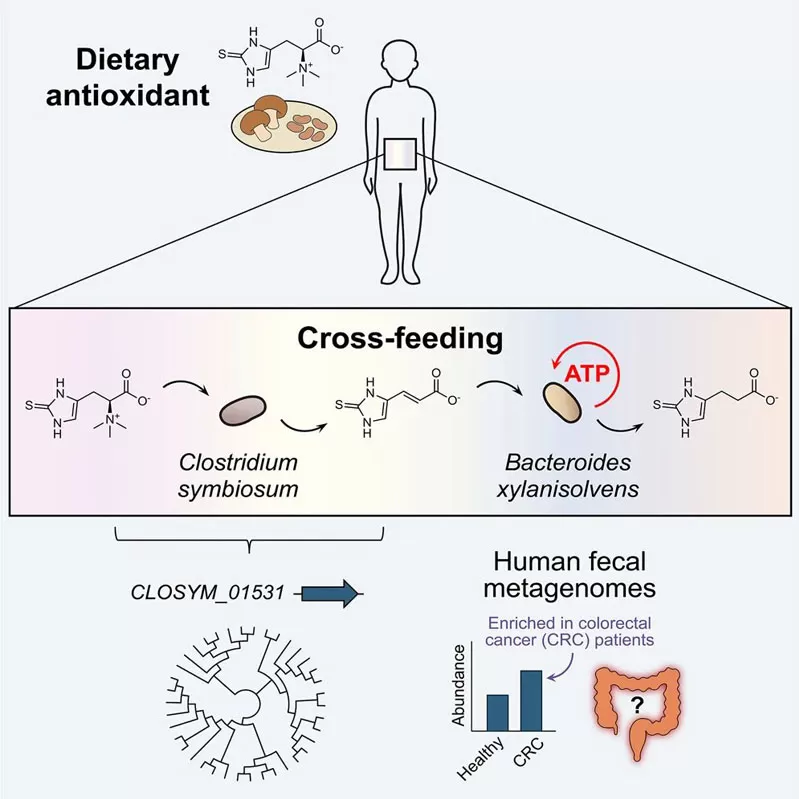
Collectively, these results demonstrate that symbiotic cross-feeding of antioxidant nutrients enhances microbial energy metabolism—a mechanism that may explain interindividual variability in disease risk susceptibility.
Paper link: https://www.cell.com/cell-host-microbe/fulltext/S1931-3128(25)00280-X

Professor and Ph.D. Supervisor, School of Pharmaceutical Sciences, Southern Medical University. Head of the Functional Ingredient R&D Center, Natural Field. Professor Chong Li is a distinguished researcher in the field of advanced drug delivery systems and pharmaceutical technology innovation.
 EN
EN
 es
es  jp
jp  ko
ko  fr
fr  de
de  it
it  ru
ru  pt
pt  th
th  ar
ar  ms
ms