
Choosing the right functional ingredient is only the first step in developing a successful nutraceutical product.
For product developers, the real challenge often comes later: maintaining ingredient stability, achieving consistent delivery, managing compatibility between actives, and translating the potential of an ingredient into a practical finished formulation.
This is where delivery technology can make a difference.
Rather than simply adding more functional ingredients to a formula, advanced delivery systems give formulators another way to think about how ingredients are protected, delivered, and combined.
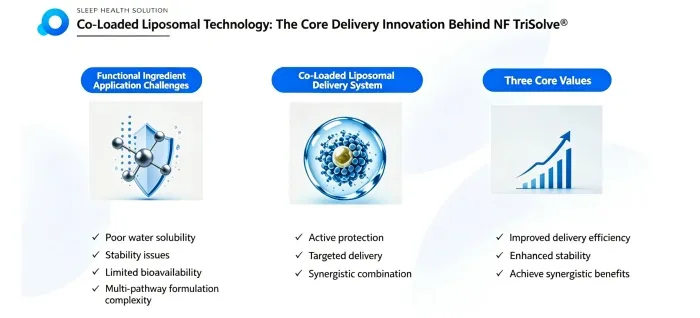
Many functional ingredients have formulation challenges of their own.
Some have limited water solubility. Others can be sensitive to environmental conditions or may require careful handling during processing. Botanical actives can also present challenges when developers try to achieve meaningful inclusion levels without compromising taste, dosage form, or overall product experience.
These challenges do not necessarily reflect a limitation of the ingredient itself. They highlight an important distinction between ingredient potential and finished-product performance.
For product developers, the question is therefore not simply:
Does this ingredient have functional value?
It is also How can we deliver it effectively in the final formulation?
Liposomal delivery uses phospholipid-based structures to encapsulate selected active compounds. Depending on the characteristics of the ingredient and the formulation, this approach can help improve protection, dispersibility, and delivery performance.
The value of a liposomal system, however, depends on how it is designed.
A delivery system should not be treated as a technology layer added after the formulation has already been developed. Ideally, the characteristics of the active ingredient, the intended dosage form, the processing conditions, and the delivery system should be considered together.
This is particularly relevant when multiple functional ingredients are being used in the same product.
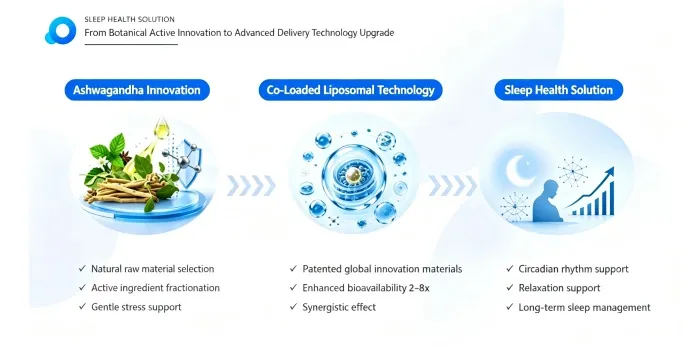
A conventional multi-ingredient formula may simply place several actives into the same capsule, powder, or liquid.
Co-loaded liposomal delivery takes a different approach.
Selected active ingredients can be incorporated into the same liposomal carrier system, allowing formulators to consider their delivery as part of the overall formulation strategy.
One example is the combination of Ashwagandha and melatonin.
These ingredients are commonly associated with different aspects of sleep health. Melatonin is primarily used to support circadian rhythm and sleep onset, while Ashwagandha is increasingly explored for its role in stress adaptation and sleep-related wellness.
For a sleep formulation built around multiple pathways, bringing these two actives into a co-loaded delivery system creates an opportunity to design the formulation around their complementary roles rather than simply placing them side by side.
The goal is not to add more ingredients. It is to develop a more deliberate relationship between ingredient selection, delivery technology, and formulation performance.
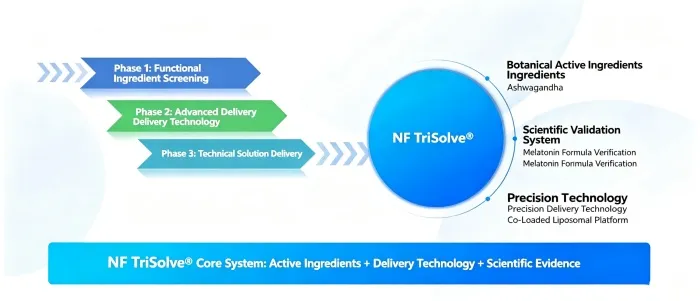
Natural Field applies this approach in NF TriSolve® Sleep Health Solution, a multi-pathway sleep formulation developed on its proprietary co-loaded liposomal platform.
The formulation combines an Ashwagandha liposomal complex with melatonin, alongside GABA, L-theanine, magnesium glycinate, 5-HTP, vitamin B6, and celery seed extract.
Its formulation strategy addresses three complementary aspects of sleep health:
Circadian rhythm support through melatonin
Neurotransmitter balance through GABA, L-theanine, and magnesium glycinate
Stress adaptation through Ashwagandha
The solution illustrates how delivery technology can become part of the formulation concept rather than simply an additional processing technology.
Natural Field has further evaluated the formulation using zebrafish insomnia models, behavioral assessment, and qRT-PCR analysis of sleep-related gene expression. This research is designed to examine both observable sleep-related behavior and potential molecular mechanisms.
For brands, the broader takeaway is straightforward: delivery technology can be considered alongside ingredient selection from the earliest stages of product development.
Not every delivery technology is suitable for every active ingredient or finished dosage form.
Before selecting a platform, product developers should consider several practical questions:
What formulation challenge is the delivery system designed to address?
Which active ingredients are suitable for the technology?
How stable is the delivery system during processing and storage?
Can the system withstand the temperature, pH, and processing conditions required for the finished product?
What evidence supports the delivery system and the finished formulation?
Can the technology be scaled to commercial manufacturing?
What are the minimum order quantities and customization options?
These questions help move the discussion beyond "Does this technology sound innovative?" toward a more useful question:
"Does this technology make sense for our product?"
Liposomal formulations generally involve additional processing, raw materials, and quality-control requirements compared with conventional ingredient blends. The final cost depends on the active ingredients, loading level, delivery system, dosage form, production scale, and customization requirements.
For commercial projects, the cost should therefore be evaluated at the finished formulation level, rather than based solely on the price per kilogram of the delivery material.
Heat stability depends on the specific liposomal system, active ingredients, processing conditions, and exposure time. Liposomal structures should not automatically be assumed to be suitable for high-temperature processing.
For applications involving heat-sensitive processes, the delivery system should be evaluated under the actual manufacturing conditions. Natural Field can assess formulation compatibility based on the intended dosage form and process requirements.
Ashwagandha and melatonin can play complementary roles in a sleep formulation. Melatonin is commonly used for circadian rhythm and sleep-onset support, while Ashwagandha is associated with stress adaptation and sleep-related wellness.
Co-loading them within a liposomal delivery system allows these selected actives to be considered within one integrated delivery strategy, rather than simply combining separate ingredients in the same finished product.
The practical advantage depends on the specific formulation and delivery design and should be supported by appropriate product-level testing.
MOQ depends on the specific formulation, active ingredients, dosage form, production requirements, and whether the project involves a standard solution or customized development.
For brands evaluating a new formulation, Natural Field can provide project-specific information on MOQ, sampling, customization, and commercial production based on the intended application.
Potential compatibility depends on the physicochemical properties of each active ingredient and the design of the liposomal system. Not every ingredient is suitable for co-loading.
A technical evaluation is recommended before combining multiple actives, particularly when the formulation involves different solubility characteristics, stability requirements, or processing conditions.
Functional ingredients remain the foundation of nutraceutical product development. But as the market becomes more competitive, the way those ingredients are formulated and delivered can become an important part of product differentiation.
Advanced delivery technologies, including co-loaded liposomal systems, offer formulators another tool for addressing ingredient-specific challenges and developing multi-pathway products.
For Natural Field, this is the thinking behind NF TriSolve®: bringing together functional ingredients, delivery technology, formulation design, and scientific validation to create solutions for specific product development needs.
For brands exploring next-generation nutraceutical formulations, the question may no longer be simply:"Which ingredients should we use?"
It may be:How can we deliver the right ingredients more effectively?
Interested in applying liposomal technology to a new functional product?
Download our co-loaded liposomal formulation whitepaper to learn more about the technology and its potential applications, or contact our technical team to discuss formulation requirements and sample availability.
Natural Field works with supplement brands and manufacturers on ingredient selection, formulation development, delivery technology, and commercial-scale solutions.

Professor and Ph.D. Supervisor, School of Pharmaceutical Sciences, Southern Medical University. Head of the Functional Ingredient R&D Center, Natural Field. Professor Chong Li is a distinguished researcher in the field of advanced drug delivery systems and pharmaceutical technology innovation.


 EN
EN
 es
es  jp
jp  ko
ko  fr
fr  de
de  it
it  ru
ru  pt
pt  th
th  ar
ar  ms
ms