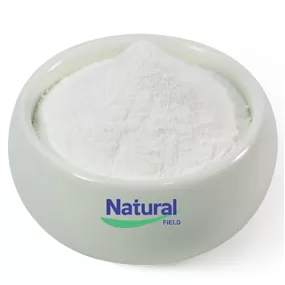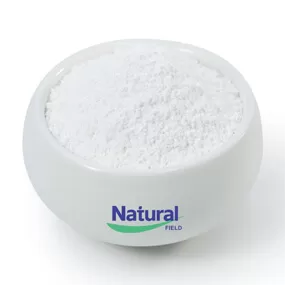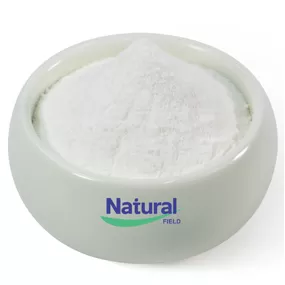

Selecting the right creatine monohydrate powder bulk supplier requires more than comparing prices. Ingredient brands, importers, distributors, and contract manufacturers need to review particle size, dispersibility, bulk density, quality documents, testing capability, production stability, packaging options, and export support. Compared with regular 200 mesh creatine monohydrate powder, micronized creatine monohydrate powder is processed by advanced jet milling technology to achieve a finer particle size, usually around 1000–2000 mesh. This helps improve powder dispersion in liquid systems and supports smoother commercial formulation development.
For companies comparing China creatine monohydrate powder manufacturers, Natural Field provides micronized powder options, bulk supply, documentation support, and raw material sourcing services.
Micronized creatine monohydrate powder is creatine monohydrate raw material that has been further processed through fine grinding technology to reduce particle size. Natural Field’s micronized version is developed to improve powder dispersion, reduce visible sediment, and support commercial formulation applications where powder appearance, mixing performance, and processing stability are important.
The commonly referenced creatine monohydrate CAS number is CAS 6020-87-7. This identity should be confirmed on the specification sheet, COA, and internal quality documents before procurement.
When companies search for China creatine monohydrate powder suppliers, creatine monohydrate powder manufacturers, or bulk creatine monohydrate powder supplier, they are usually looking for a raw material partner that can provide stable supply, quality documentation, and technical communication. Micronized powder gives formulation teams an additional specification option for projects requiring faster dispersion and reduced sediment.
Natural Field’s micronized creatine monohydrate powder uses advanced jet milling technology to refine creatine particles to a micron-level range. This process increases the specific surface area of the powder and optimizes its dispersion characteristics in liquid systems from a physical structure perspective.
Particle size can influence powder handling, blending uniformity, dispersion speed, sediment appearance, and final product consistency. While standard creatine monohydrate powder can meet general raw material needs, micronized powder offers improved application performance for brands seeking better formulation compatibility.
This makes micronized creatine monohydrate suitable for projects involving creatine monohydrate powder bulk. For companies comparing China creatine monohydrate powder factory options, micronized processing capability can also reflect a supplier’s manufacturing refinement and application support.
One of the main differences between regular 200 mesh creatine monohydrate powder and micronized creatine monohydrate powder is dispersion performance.
Regular powder may require stronger shaking, longer stirring, or additional processing support in certain liquid applications. Natural Field’s micronized powder is designed for faster dispersion and reduced visible sediment. Based on the comparison data, micronized creatine monohydrate powder can reach 1000–2000 mesh and can disperse well with normal stirring in about 1–3 minutes.
| Key Indicator | Regular Product | Micronized Creatine Monohydrate Powder |
| Mesh Size | 200 mesh | 1000–2000 mesh |
| Dispersion at 25°C | General; may require ultrasonic treatment or longer stirring | Good; normal stirring for 1–3 minutes |
| Application Experience | May have slight graininess and sediment | Finer texture with reduced gritty feeling |
| Bulk Density | 0.45–0.55 g/ml | 0.15–0.25 g/ml |
| Total Microbial Count | ≤1000 cfu/g | ≤1000 cfu/g |
This comparison is useful for powder blends, instant powder systems, beverage powder applications, and other commercial formulation projects. It also helps procurement and formulation teams explain why micronized specifications may be selected over regular 200 mesh material in certain development cases.
For brand owners and contract manufacturers, switching from regular 200-mesh to micronized creatine typically addresses five common formulation challenges: slow dispersion during pilot testing, visible sediment in finished liquids, gritty texture in powdered blends, batch-to-batch variation in mixing uniformity, and higher processing costs due to extended mixing times. Micronization offers a practical solution to all five without changing the active ingredient identity.
Product performance should be supported by a reliable quality system. Natural Field’s micronized creatine monohydrate powder is developed with attention to global raw material quality expectations, internal testing capability, and standardized production management.
Natural Field’s micronized creatine monohydrate powder is designed to meet USP-related quality expectations, helping improve its suitability for international raw material procurement. When reviewing creatine monohydrate CAS, creatine monohydrate cas number, or Spec of creatine monohydrate CAS 6020-87-7, companies should carefully check supplier documentation before purchase.
Natural Field operates its own CNAS-recognized testing laboratory. This supports internal testing capability and helps align quality control with international testing expectations. Laboratory capability is important for raw material evaluation, batch testing, document review, and supplier qualification.
Natural Field has FSSC 22000 system certification, supporting standardized production control from raw material selection to finished raw material output. For China creatine monohydrate powder suppliers, this type of system certification helps demonstrate stronger food safety and process management capability.
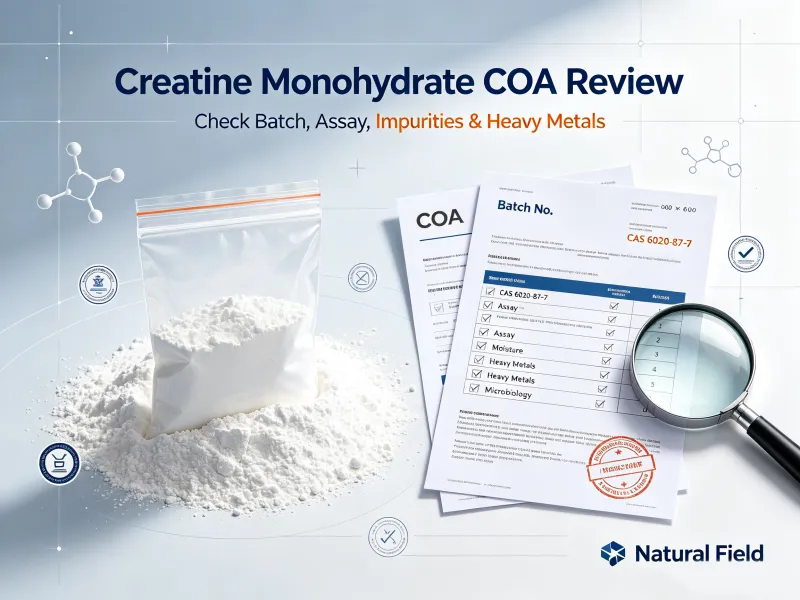
Natural Field applies a dual inspection mechanism combining enterprise internal control and third-party rechecking. Heavy metals, microbial indicators, and impurity residues are screened through frequent testing, helping support commercial raw material quality requirements.
When evaluating a creatine monohydrate supplier, procurement teams should request updated product documents and confirm whether the supplier can support both regular and micronized specifications.
| Item | What Buyers Should Confirm | Why It Matters |
| Product Name | Micronized Creatine Monohydrate Powder | Confirms the exact raw material specification |
| CAS Number | CAS 6020-87-7 | Supports technical identification |
| Particle Size | 1000–2000 mesh | Indicates micronized powder specification |
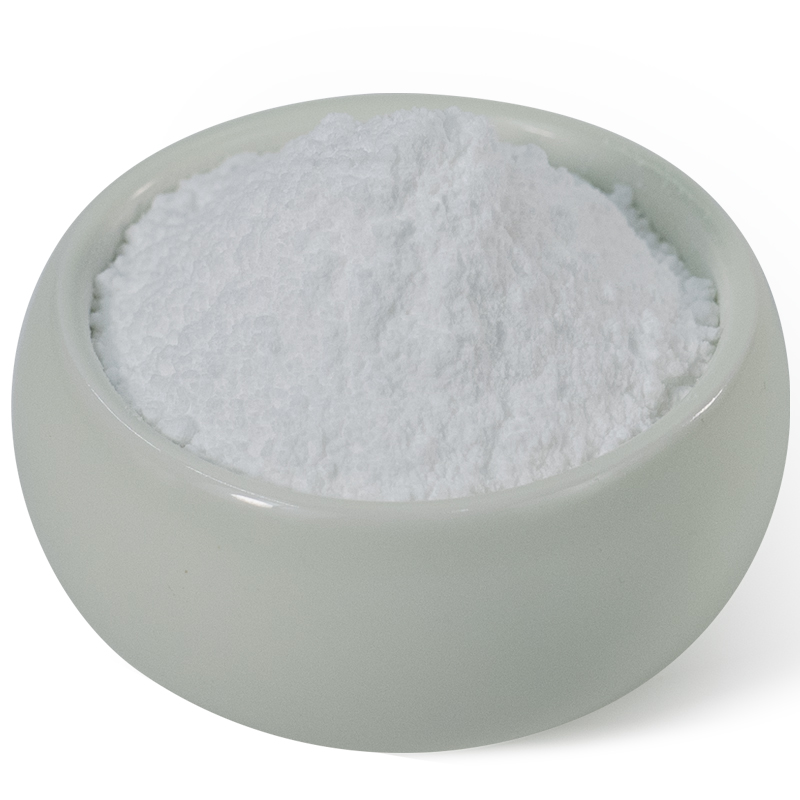
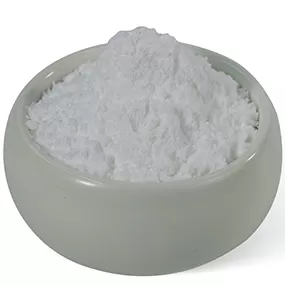
| Appearance | White powder | Supports incoming inspection |
| Bulk Density | 0.15–0.25 g/ml | Affects filling, handling, and packaging |
| Dispersion Performance | 1–3 minutes under normal stirring | Helps evaluate application suitability |
| COA/MSDS | Batch-level quality and handling documents | Supports procurement review |
| Certificates | CNAS lab, FSSC 22000, USP-related quality standard, other relevant certificates | Supports supplier qualification |
| Testing Items | Heavy metals, microbial indicators, impurity residues | Supports quality control |
| Supply Model | Bulk, wholesale, distributor, exporter support | Supports long-term procurement planning |
Creatine monohydrate powder generally involves raw material reaction, purification, crystallization, drying, sieving or milling, quality testing, and packaging. For micronized creatine monohydrate powder, an additional fine grinding step is added to reduce particle size and improve powder dispersion properties.
A simplified production flow may include:
Raw material preparation
Controlled reaction and purification
Crystallization and drying
Sieving or regular powder processing
Jet milling for micronized powder
Batch testing and COA preparation
Bulk packaging and export document preparation
When reviewing how is creatine monohydrate powder manufactured production process, the key point is whether the China creatine monohydrate powder manufacturers can control impurities, moisture, microbial indicators, particle size, and batch consistency.
For long-term commercial procurement, a factory or manufacturer-supported supplier is usually more suitable because technical specifications, particle size, COA/MSDS, packaging, MOQ, lead time, and quality standards can be discussed more directly.
A distributor may be useful for regional inventory and faster shipment, but original manufacturer documents and batch traceability should still be confirmed. A reseller may support small-volume transactions, but may be less suitable for enterprise-level creatine monohydrate raw material procurement if documentation and long-term supply continuity are limited.
For companies planning to buy creatine monohydrate in bulk, supplier qualification should focus on product identity, factory background, quality documents, specification control, and export support.
Natural Field is positioned as one of the nutraceutical raw material suppliers focused on nutrition ingredients raw material, nutritional ingredients raw material, and commercial ingredient powder supply. Its one-stop solution supports formulation development, sample evaluation, technical communication, and commercial production planning, while the core purpose remains raw material supply.
For buyers comparing reliable Chinese creatine monohydrate powder manufacturer wholesale options, Natural Field can support bulk raw material procurement with micronized specification options, quality documents, and formulation-oriented communication.
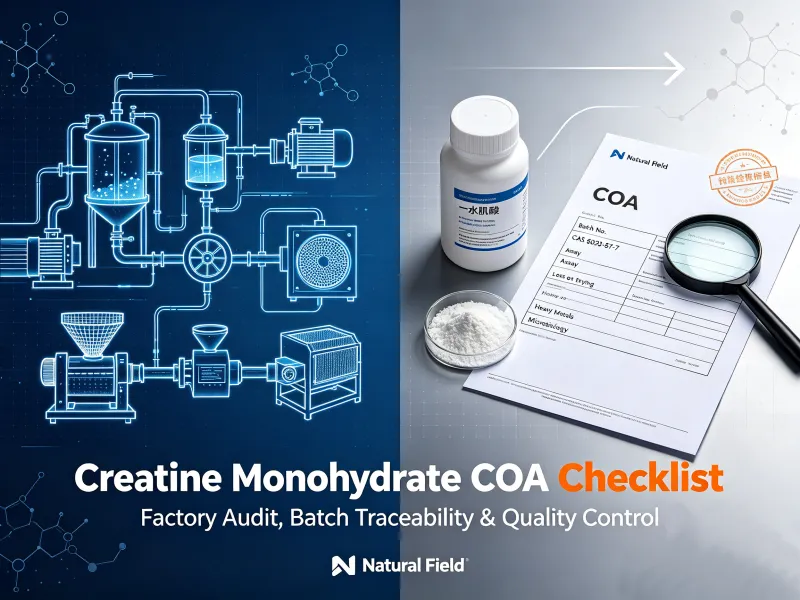
When we're vetting a micronized creatine supplier for bulk procurement, here are the six things we always dig into – not just what's on the spec sheet, but what actually matters on the production line.
Can they handle both regular and micronized grades?
Some projects need 200‑mesh, others need the finer stuff. A decent China creatine factory should be able to switch between them without missing a beat.
How consistent is their particle size?
We're looking for batch‑to‑batch stability in the 1000–2000 mesh range – because if that drifts, your dispersion time goes from 2 minutes to 10, and that kills your mixing efficiency.
Is the documentation solid?
COA, MSDS, and the CAS 6020‑87‑7 identity verification – these aren't just paperwork; they're what get your shipment through customs and keep your QA team happy. Don't accept generic copies – ask for lot‑specific files.
How transparent are they with testing?
A real supplier will have their own CNAS‑accredited lab and also welcome third‑party re‑checks. Heavy metals, microbial counts, residual impurities – we want to see the actual numbers, not just a "pass" stamp.
What's their real production capacity?
They claim 100+ tons per month, but can they sustain that during peak seasons? We need that scale to back up long‑term bulk orders – otherwise we're shopping again in six months.
Do they hold the right certifications?
FSSC 22000 and USP‑aligned quality systems are non‑negotiable if you're selling into international sports nutrition or food markets. It's not just a badge – it tells you how they run their entire operation.
That checklist is what separates a manufacturer with real formulation support from a trader who's just flipping bags. Before you sign off on a bulk order, get the actual batch COAs and third‑party lab reports, and tick off every single point. Don't rely on a glossy sales deck – verify.
Micronized creatine monohydrate powder is creatine monohydrate raw material processed through fine grinding technology to achieve smaller particle size. Natural Field's micronized powder can reach about 1000–2000 mesh, supporting improved dispersion performance for commercial formulation projects.
The commonly referenced creatine monohydrate CAS number is CAS 6020-87-7. B2B buyers should confirm this number on the specification sheet, COA, and supplier documents.
B2B buyers can source from a qualified China creatine monohydrate powder factory, manufacturer, supplier, exporter, or distributor. Buyers should evaluate product specification, COA/MSDS, certifications, particle size, packaging, lead time, and export support before procurement.
Regular powder is commonly around 200 mesh, while micronized creatine monohydrate powder can reach 1000–2000 mesh. Micronized powder has finer particles, better dispersion performance, and reduced sediment in liquid systems.
Yes. Natural Field supplies creatine monohydrate powder for B2B customers and offers micronized powder specifications, bulk supply, quality documentation, CNAS laboratory testing support, FSSC 22000 system certification, and wholesale cooperation for commercial raw material projects.
How to Choose the Right Nutraceutical Ingredients Supplier for Your Business?
The Safety of Creatine Monohydrate: A Supplement to Use with Confidence
Creatine Monohydrate: A Must-Have Supplement for Athletes and Fitness Enthusiasts
Why Is Creatine Monohydrate Powder So Popular?
Selecting Quality Creatine Monohydrate Powder: A Professional Buying Guide

Professor and Ph.D. Supervisor, School of Pharmaceutical Sciences, Southern Medical University. Head of the Functional Ingredient R&D Center, Natural Field. Professor Chong Li is a distinguished researcher in the field of advanced drug delivery systems and pharmaceutical technology innovation.
 EN
EN
 es
es  jp
jp  ko
ko  fr
fr  de
de  it
it  ru
ru  pt
pt  th
th  ar
ar  ms
ms