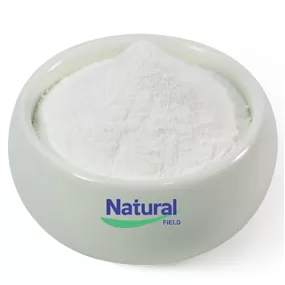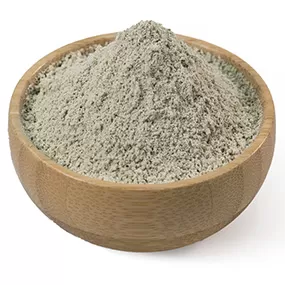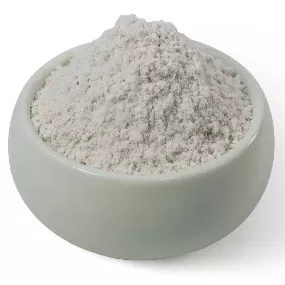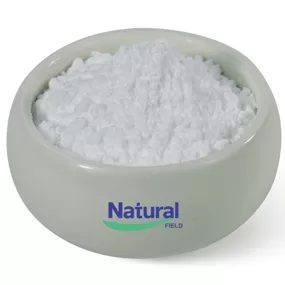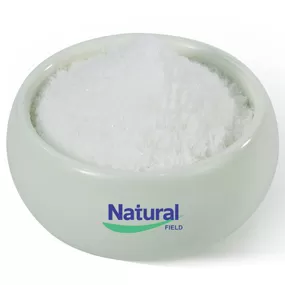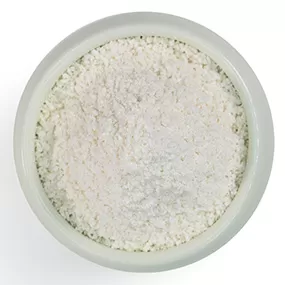

Despite its growing popularity, micronized creatine is often misunderstood.
Some assume it represents a new generation of creatine or that micronization changes the ingredient's effectiveness. In reality, neither is true.
Micronized creatine monohydrate is simply creatine monohydrate powder that has been processed into much smaller particles using advanced milling technology.
The active ingredient remains exactly the same.
The same molecular structure
The same nutritional profile
The same CAS Number: 6020-87-7
The same purity standards expected from high-quality creatine monohydrate manufacturers
The only significant difference is the powder's physical size.
Reducing particle size doesn't change what creatine is—it changes how the powder behaves during manufacturing and formulation.
This distinction is particularly important for product developers.
As supplement formats become more sophisticated, manufacturers are looking beyond ingredient purity. Powder flow, blending consistency, dispersion behavior, and finished-product appearance all influence production efficiency and customer experience.
That's why many brands are beginning to evaluate micronized grades alongside conventional creatine monohydrate bulk materials.
Several market trends are driving demand for finer creatine powders.
First, today's supplement market extends well beyond traditional bodybuilding products. Consumers now expect creatine to be available in flavored drink powders, convenient stick packs, functional beverages, gummies, and daily wellness supplements.
These newer dosage forms often require powders that disperse more uniformly and blend consistently with multiple functional ingredients.
Second, premium supplement brands are placing greater emphasis on product quality from the consumer's perspective.
A powder that mixes smoothly, looks uniform, and leaves less visible sediment contributes to a more refined product experience—even when the active ingredient itself remains unchanged.
Finally, contract manufacturers and OEM producers are increasingly optimizing production efficiency. Consistent particle size can help simplify blending, improve powder distribution, and reduce variability during large-scale manufacturing.
For these reasons, micronized creatine has become an increasingly attractive option for companies sourcing creatine monohydrate raw material for premium formulations.
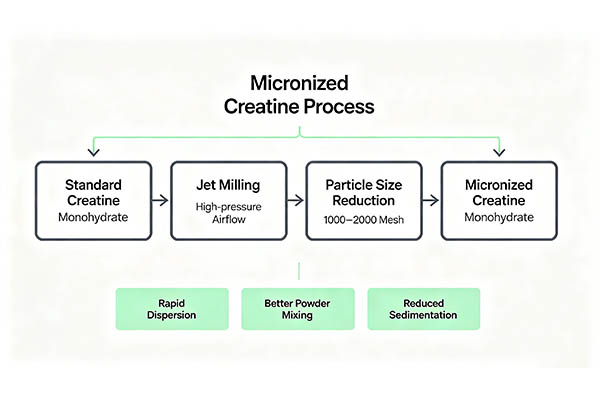
Natural Field's micronization process reduces conventional creatine monohydrate into an ultra-fine 1000–2000 mesh powder, creating a product designed for advanced dietary supplement manufacturing.
Compared with standard grades, the micronized powder offers:
Ultra-fine particle size (1000–2000 mesh)
Increased surface area
Faster wetting during mixing
More uniform dispersion
Reduced powder agglomeration
Improved compatibility with multi-ingredient formulations
It's important to emphasize that these are physical processing advantages, not changes in nutritional efficacy.
Whether a manufacturer selects conventional or micronized creatine monohydrate powder, both ingredients deliver the same active compound. The decision typically depends on formulation requirements, processing efficiency, and the desired characteristics of the finished product.
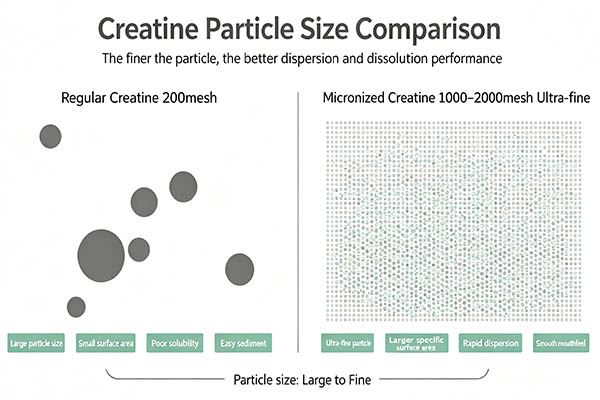
When evaluating a creatine monohydrate raw material, purity is only one part of the equation. For formulation scientists and manufacturing teams, particle size is another specification that can significantly influence how an ingredient performs during production.
This doesn't mean a finer powder changes the biological role of creatine. Instead, it changes how the powder behaves throughout processing—from blending and filling to dispersion in the finished product.
One way to visualize this is to imagine pouring coarse sugar and powdered sugar into water. Both are chemically similar, but their physical behavior is noticeably different because of particle size.
The same principle applies to micronized creatine monohydrate.
By reducing particle size through jet milling, each particle exposes more surface area when it comes into contact with liquid. This allows water to wet the powder more quickly and helps create a more uniform dispersion during mixing.
For manufacturers producing premium nutritional products, these physical improvements can simplify formulation while contributing to a more consistent finished product.
One of the defining characteristics of Natural Field's micronized series is its ultra-fine 1000–2000 mesh particle size.
In simple terms, "mesh" describes how fine a powder is. A higher mesh number generally indicates a finer particle size.
Compared with conventional creatine monohydrate powder, a 1000–2000 mesh grade offers several formulation advantages:
Greater surface area exposed to liquid
Faster powder wetting during mixing
More homogeneous blending with other ingredients
Reduced visible sediment in beverage applications
Better compatibility with complex nutritional formulations
For R&D teams, selecting the right particle size is often just as important as selecting the right ingredient itself.
As supplement delivery systems continue to evolve, powders must perform consistently across a wide range of applications—from powdered beverages to gummies and functional nutrition products.
This is one of the questions we hear most frequently from customers.
The short answer is:Not exactly. Micronization does not fundamentally change the intrinsic water solubility of creatine monohydrate. The molecule remains the same before and after micronization.
What changes is the powder's physical behavior.
Because the particles are significantly smaller, micronized creatine tends to:
Wet more quickly after contacting water
Disperse more evenly during mixing
Remain suspended for longer before settling
Produce a smoother-looking beverage
Reduce visible clumping during preparation
This distinction is important.
In technical discussions, terms such as dispersion, wetting, and suspension stability are often more accurate than simply saying "better solubility."
For supplement manufacturers, these characteristics can improve formulation efficiency without altering the nutritional profile of the ingredient.
From a consumer's perspective, dispersion influences how a powdered supplement looks and feels after mixing.
From a manufacturer's perspective, it affects production consistency.
Poorly dispersed powders may require longer mixing times, additional processing steps, or formulation adjustments to achieve a uniform finished product.
Micronized powders help simplify this process by distributing more evenly throughout the formulation.
This is particularly valuable when creatine is combined with multiple functional ingredients such as:
Amino acids
Electrolytes
Vitamins
Botanical extracts
Mineral blends
Functional carbohydrates
As formulations become more sophisticated, maintaining consistent powder distribution becomes increasingly important for product quality.
Traditional creatine monohydrate powder continues to be one of the most trusted ingredients in sports nutrition, and for many applications it performs extremely well.
However, as supplement formats evolve, conventional particle sizes can present several practical formulation challenges.
These challenges are related to powder handling rather than ingredient quality.
Creatine monohydrate has naturally limited water solubility.
When conventional particles are dispersed in water, some particles may hydrate more slowly and gradually settle to the bottom of the container over time.
For powdered beverages, this can create visible sediment after standing, particularly in high-dose formulations.
While sedimentation does not reduce the effectiveness of creatine, it may influence the appearance of the finished product and overall user perception.
Micronized grades help create a more uniform suspension, reducing the amount of visible settling during normal consumption.
Particle size also affects texture.
Larger undispersed particles can create a slightly gritty or chalky sensation, especially in beverage powders where complete dispersion is difficult to achieve.
This becomes increasingly important in premium products where consumers expect a smoother drinking experience.
By reducing particle size through micronization, manufacturers can improve the physical texture of powdered formulations without changing the active ingredient itself.
Modern dietary supplements rarely contain a single ingredient.
Today's formulations often combine creatine with proteins, collagen peptides, electrolytes, botanical extracts, vitamins, minerals, sweeteners, flavors, and functional fibers.
When ingredients have significantly different particle sizes, achieving a homogeneous blend can become more challenging.
Ultra-fine micronized creatine monohydrate integrates more easily into these complex formulations, helping manufacturers achieve greater batch-to-batch consistency while simplifying production.
Choosing a micronized grade is not about replacing conventional creatine—it is about selecting the most appropriate material for a specific application.For many supplement manufacturers, the value lies in improved processing performance.
Smaller particles become wet more rapidly and distribute more evenly throughout liquid systems, helping reduce clumping during mixing.
Micronized powders mix more consistently with complementary ingredients, making them well suited for complex formulations containing multiple active compounds.
A more uniform particle size can contribute to smoother industrial mixing, filling, and packaging operations, particularly in large-scale production.
As consumers continue to demand more convenient supplement formats, micronized ingredients are increasingly being selected for products such as:
Instant drink powders
Stick packs
Ready-to-drink beverages
Functional beverage premixes
Gummies
Protein blends
Healthy aging supplements
Daily wellness formulas
For brands seeking to differentiate their products through quality and user experience, micronized creatine monohydrate offers additional formulation flexibility while maintaining the proven efficacy of traditional creatine monohydrate powder.
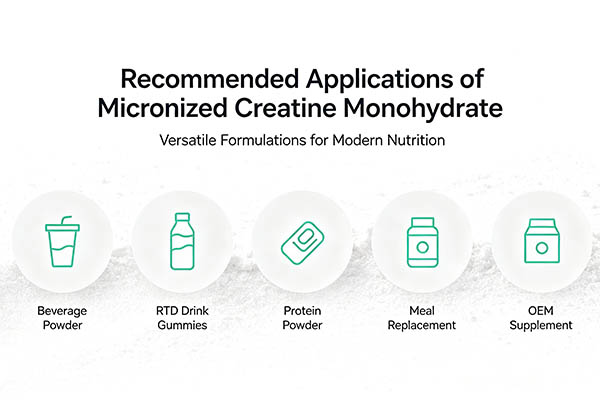
As the dietary supplement industry continues to innovate, creatine is no longer limited to traditional sports nutrition products. Today, formulators are incorporating micronized creatine monohydrate into a much broader range of applications, where particle size and processing performance can be just as important as ingredient purity.
For product developers, choosing the right grade of creatine monohydrate powder often depends on the intended dosage form and manufacturing process rather than the active ingredient itself.
Because micronized creatine disperses more uniformly and blends more consistently with other functional ingredients, it has become an increasingly popular option for premium formulations.
Common applications include:
Sports Nutrition Powders
Sports nutrition remains the largest application for creatine. Micronized grades help improve powder handling during manufacturing while creating a smoother mixing experience for finished drink powders.
Functional Beverage Premixes
As functional beverages continue to grow worldwide, manufacturers require ingredients that disperse quickly and remain visually appealing after mixing.
The ultra-fine particle size of micronized creatine makes it well suited for powdered beverage concentrates and instant drink formulations where suspension quality matters.
Stick Packs and Single-Serve Sachets
Single-serve packaging demands excellent powder consistency.
A more uniform particle size can help improve filling accuracy and blending performance during high-speed production, making micronized grades an attractive option for stick packs and travel-friendly products.
Gummies and Innovative Delivery Formats
The creatine market is expanding beyond traditional powders.
Many supplement brands are now developing creatine monohydrate gummies, chewables, and other convenient delivery systems designed for consumers seeking greater convenience.
Although formulation requirements vary by product type, micronized powders can offer better compatibility with multi-ingredient systems during manufacturing.
Healthy Aging and Daily Wellness Products
Recent scientific interest has broadened creatine's application beyond athletic performance.
Many brands are now exploring creatine as part of healthy aging, cognitive wellness, and daily nutrition formulas.
For these premium products, manufacturers often prioritize ingredients that combine proven efficacy with consistent processing characteristics.
Selecting a creatine monohydrate supplier involves much more than comparing prices.
For supplement manufacturers, ingredient quality is closely tied to manufacturing consistency, technical support, regulatory documentation, and long-term supply reliability.
Whether you're sourcing creatine monohydrate powder bulk for an existing product line or developing a new formulation, evaluating your supplier carefully can reduce production risks and improve overall product quality.
Here are several factors worth considering.
Manufacturing Capability
Not all creatine monohydrate manufacturers offer micronized grades.
If your formulation requires ultra-fine powder specifications, ask whether the supplier has dedicated micronization equipment rather than relying solely on conventional milling.
A manufacturer with in-house jet milling capabilities is generally better positioned to deliver consistent particle size from batch to batch.
Particle Size Consistency
Mesh size alone does not tell the whole story.
Professional ingredient suppliers should also maintain tight control over particle-size distribution to ensure manufacturing consistency.
For premium formulations, consistency is often more valuable than simply achieving the smallest possible particle size.
Quality Documentation
Reliable suppliers should be able to provide complete technical documentation, including:
Certificate of Analysis (COA) Product Specification Sheet Safety Data Sheet (SDS/MSDS) Heavy Metal Testing Microbiological Testing Stability Information
These documents help simplify qualification for OEM manufacturers and regulatory compliance across different markets.
Supply Stability
For growing supplement brands, an interrupted ingredient supply can delay production schedules and affect customer relationships.
When evaluating creatine monohydrate powder manufacturers, consider factors such as production capacity, inventory management, and export experience.
A supplier with established international logistics can often provide greater flexibility for long-term purchasing plans.
China has become one of the world's major production bases for nutritional ingredients, supplying dietary supplement manufacturers across North America, Europe, Southeast Asia, and other international markets.
For companies sourcing China creatine monohydrate powder, the focus has shifted from cost alone to manufacturing quality, production consistency, and technical capabilities.
Experienced Chinese manufacturers increasingly invest in advanced processing technologies such as micronization, automated production systems, and comprehensive quality management programs to meet international market expectations.
As a result, many global brands now evaluate suppliers based on their ability to provide consistent specifications, reliable documentation, and responsive technical support rather than simply comparing quotations.
At Natural Field, we understand that ingredient sourcing is about more than purchasing a raw material.
Every formulation has different technical requirements, production processes, and positioning strategies.
That's why we offer both conventional creatine monohydrate powder and an ultra-fine micronized series, giving customers greater flexibility when selecting the most appropriate material for their products.
Our micronized creatine features:
Ultra-fine 1000–2000 mesh particle size
Advanced jet milling technology
Consistent batch-to-batch quality
High-purity creatine monohydrate raw material
Comprehensive quality documentation
Stable global supply for OEM manufacturers, brand owners, and distributors
Whether you're purchasing creatine monohydrate bulk for sports nutrition, healthy aging formulations, functional beverages, or innovative delivery systems, our technical team works closely with customers to identify the most suitable ingredient specification for each project.
As an experienced creatine monohydrate supplier, Natural Field supports supplement manufacturers with reliable production, flexible supply, and formulation-focused technical service.
Looking for a Reliable Micronized Creatine Monohydrate Supplier?
If you're developing a new supplement formula or looking to upgrade your existing creatine monohydrate raw material, selecting the appropriate particle size can improve manufacturing efficiency and expand formulation possibilities.
Natural Field offers both conventional and micronized creatine monohydrate powder to support a wide range of dietary supplement applications.
Whether your project requires wholesale creatine monohydrate powder, customized particle size, or long-term OEM supply, our team is ready to help you identify the right solution for your formulation.
Contact us today to request technical specifications, sample availability, or a customized quotation for your next project.
Micronized creatine monohydrate is standard creatine monohydrate that has undergone an additional micronization process to reduce particle size. The chemical composition remains unchanged—the difference lies in the powder's physical properties rather than its molecular structure.
Compared with conventional creatine monohydrate powder, micronized grades typically disperse more quickly and blend more uniformly, making them well suited for premium dietary supplement formulations.
Yes.Micronized creatine is still creatine monohydrate. It is not a different type of creatine and does not contain additional active ingredients.
Micronization simply produces a finer powder through physical processing while maintaining the same CAS Number 6020-87-7, purity, and nutritional characteristics.
The primary difference is particle size.
Micronized creatine contains much finer particles, which can improve powder dispersion, blending consistency, and suspension behavior during formulation.
Standard and micronized grades provide the same active ingredient. The choice usually depends on manufacturing requirements and product positioning rather than efficacy.
Not in terms of intrinsic water solubility.
Micronization does not change the chemical properties of creatine monohydrate. However, smaller particles typically wet more quickly, disperse more evenly, and remain suspended longer after mixing.
This often creates a smoother appearance and improved handling during manufacturing.
Many manufacturers select micronized grades because finer particles can support:
Faster powder dispersion
More consistent blending
Improved process efficiency
Reduced visible sedimentation
Better compatibility with multi-ingredient formulations
These advantages are particularly valuable in beverage powders, stick packs, gummies, and functional nutrition products.
Micronized creatine monohydrate is widely used in:
Sports nutrition supplements
Functional beverage powders
Ready-to-drink formulations
Gummies
Protein blends
Meal replacement products
Healthy aging supplements
Daily wellness formulations
Its versatility makes it suitable for both established and emerging supplement categories.
Yes.Because of its improved processing characteristics, micronized creatine is commonly used by OEM manufacturers and private-label brands developing premium supplement products.
Its consistent particle size can simplify production and support more uniform formulations across large manufacturing batches.
When evaluating a creatine monohydrate supplier, consider more than price.
Important factors include:
Manufacturing capability
Particle size consistency
Product purity
Quality documentation (COA, SDS/MSDS)
Batch-to-batch consistency
Export experience
Technical support
Stable long-term supply
These factors contribute to reliable production and consistent product quality.
Yes.Natural Field supplies creatine monohydrate bulk to dietary supplement brands, contract manufacturers, distributors, and private-label companies worldwide.
Both conventional and micronized grades are available depending on formulation requirements and production preferences.
Yes.Natural Field supplies both standard creatine monohydrate powder and an ultra-fine micronized series produced using advanced jet milling technology.
Our micronized products feature:
Ultra-fine 1000–2000 mesh particle size
Consistent quality
Stable global supply
Technical documentation for international markets
Flexible solutions for OEM and private-label customers
Kreider RB, et al. International Society of Sports Nutrition Position Stand: Creatine Supplementation and Exercise. Journal of the International Society of Sports Nutrition.
Kreider RB, et al. Common Questions and Misconceptions About Creatine Supplementation. JISSN.
EFSA Panel on Dietetic Products, Nutrition and Allergies. Scientific Opinion on Creatine and Physical Performance.
PubChem. Creatine Monohydrate (CAS 6020-87-7).
European Food Safety Authority (EFSA). Scientific opinions related to creatine monohydrate.
Natural Field Technical COA — Micronized Creatine Monohydrate (1000–2000 Mesh)

Professor and Ph.D. Supervisor, School of Pharmaceutical Sciences, Southern Medical University. Head of the Functional Ingredient R&D Center, Natural Field. Professor Chong Li is a distinguished researcher in the field of advanced drug delivery systems and pharmaceutical technology innovation.
 EN
EN
 es
es  jp
jp  ko
ko  fr
fr  de
de  it
it  ru
ru  pt
pt  th
th  ar
ar  ms
ms