
In recent years, NAD⁺ (nicotinamide adenine dinucleotide, commonly known as Coenzyme I) has maintained steady popularity in the anti-aging field. From groundbreaking anti-aging studies in top global academic journals like Cell, Nature, and Science, to major corporations such as Bezos and Google flocking to invest in the longevity industry focused on anti-aging research, even domestic news like Pan Shiyi sharing his NAD⁺ supplement consumption experience and Li Ka-shing investing in NAD⁺-related industries have made NAD⁺ a focal point of public attention, thanks to its core potential to regulate the aging process and support anti-aging efforts.
As NAD⁺’s popularity grew, various NAD⁺-related anti-aging supplements also gained traction. Among them, NMN (nicotinamide mononucleotide) quickly became the mainstream anti-aging supplement by branding itself as a "direct precursor of NAD⁺". But many people wonder: if the ultimate goal is to supplement NAD⁺ for anti-aging, why not take NAD⁺ directly instead of NMN? What exactly is the difference between NMN and NAD⁺ when it comes to anti-aging effects? Today, we’ll break down the distinctions between NMN and NAD⁺ from core perspectives like scientific principles, NAD⁺ absorption effectiveness, and practical anti-aging usability to help you find the right anti-aging approach for yourself.

First, it’s important to clarify a key premise for anti-aging supplementation: NAD⁺ naturally exists in every cell of our body as a core coenzyme. It’s indispensable for thousands of physiological processes closely related to anti-aging, including metabolism, DNA repair, and gene regulation. However, as we age, NAD⁺ levels in the body drop steadily—one of the core reasons we experience aging signs and a key target for anti-aging interventions. Theoretically, direct NAD⁺ supplementation seems like the most straightforward anti-aging method, but in practice, it simply doesn’t work for anti-aging purposes—the problem lies in "absorbability" of NAD⁺.
NAD⁺ has a relatively large molecular weight (663.43g/mol) and an unstable molecular structure, making it unable to directly cross cell membranes to be absorbed and utilized by cells for anti-aging effects. When we take oral NAD⁺ supplements for anti-aging, most of the NAD⁺ is broken down into small molecules like nicotinamide (NAM) in the digestive tract. Only a tiny fraction of the original NAD⁺ can enter cells and be converted into active NAD⁺, resulting in extremely poor NAD⁺ supplementation effectiveness that fails to achieve the desired anti-aging effect.
NMN, as a "direct precursor of NAD⁺", perfectly solves this NAD⁺ absorption problem for anti-aging supplementation. With a smaller molecular weight (334.22g/mol) and more stable structure, NMN can efficiently enter cells through specific transport channels on the cell surface. After a simple catalytic reaction, NMN is converted into NAD⁺, with much higher NAD⁺ supplementation efficiency than direct NAD⁺ intake. That’s why NMN is now the preferred choice for most people looking to supplement NAD⁺ for anti-aging.
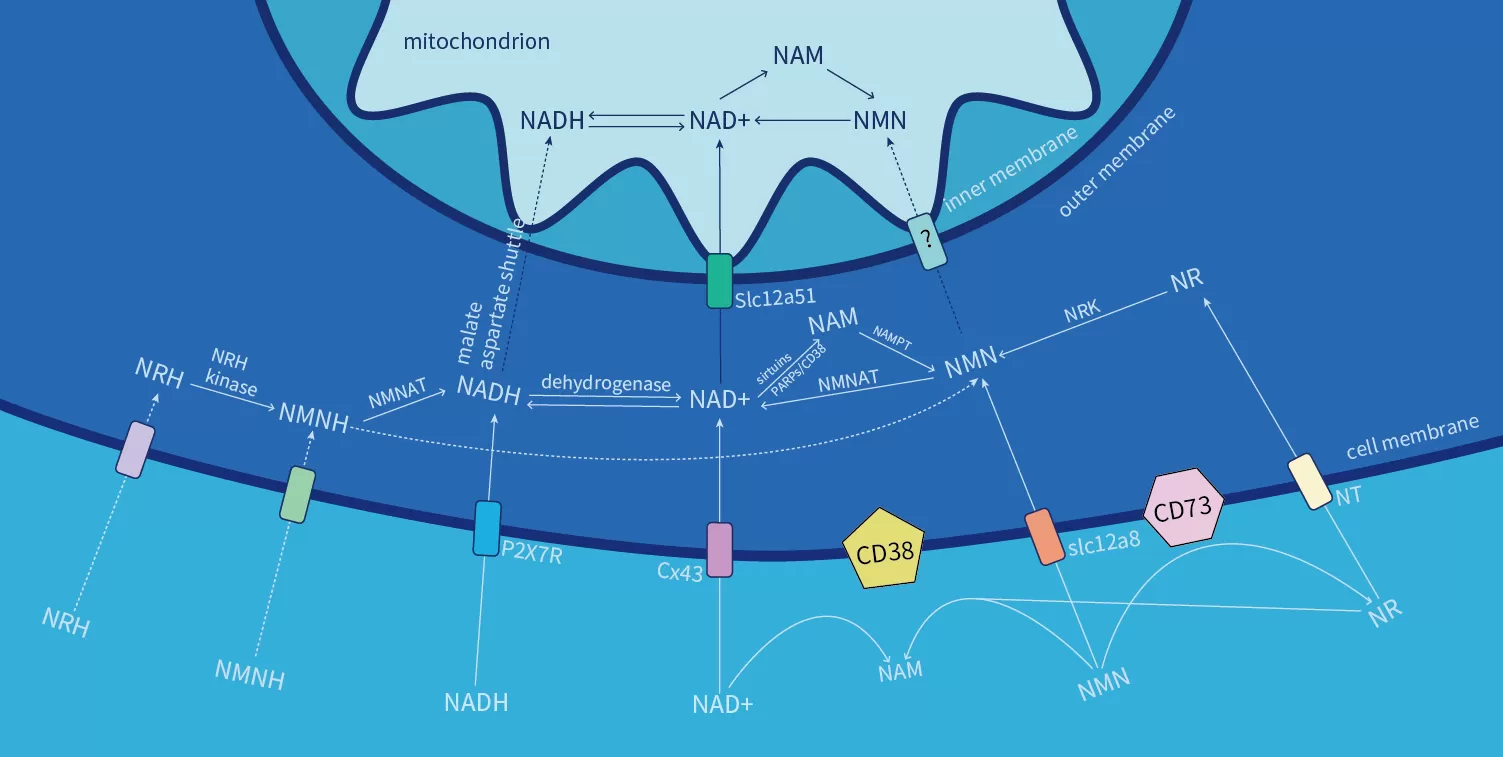
Beyond the core difference of "whether direct NAD⁺ supplementation is possible for anti-aging", NMN and NAD⁺ also vary significantly in NAD⁺ absorption methods, anti-aging action processes, and practical anti-aging effectiveness. Let’s break them down one by one to clarify which is better for your anti-aging goals:
NMN raw material has a clear and efficient absorption pathway for NAD⁺ supplementation: it can directly enter cells through the dedicated Slc12a8 transporter on the cell membrane, without going through complex decomposition and resynthesis processes that waste anti-aging ingredients. Although a small portion of NMN is broken down by glycosidases (such as CD38 and CD73) on the cell membrane surface—enzymes that also consume NAD⁺—most of the NMN enters cells in its intact form to convert into NAD⁺ and exert anti-aging effects.
NAD⁺, however, is different for anti-aging use. Due to its large molecular weight and unstable structure, NAD⁺ cannot directly enter cells through membrane transporters to deliver anti-aging benefits. After oral intake of NAD⁺ supplements, the NAD⁺ is first broken down into basic components like nicotinamide and adenine by digestive enzymes in the gastrointestinal tract. Once these components enter cells, they require multiple enzymatic reactions (relying on rate-limiting enzymes like NAMPT) to resynthesize NMN, which is then converted into NAD⁺. This process is not only cumbersome but also results in significant NAD⁺ losses. The final proportion of active NAD⁺ produced is extremely low, making direct NAD⁺ supplementation costly and ineffective for anti-aging.
In terms of action logic, both ultimately aim to increase intracellular NAD⁺ levels, but their processes are completely different:
NMN works through "indirect NAD⁺ supplementation" for anti-aging: After entering cells, NMN is converted into NAD⁺ in one step under the catalysis of NMNAT (nicotinamide mononucleotide adenylyltransferase), directly increasing intracellular NAD⁺ concentration—the key to activating anti-aging pathways. This increased NAD⁺ in turn provides energy for core anti-aging pathways involving sirtuins (longevity proteins) and PARP (DNA repair enzymes), which are critical for slowing aging. Simply put, NMN is like a "semi-finished product" of NAD⁺ for anti-aging—once inside cells, it only needs a little processing to become active NAD⁺ that drives anti-aging effects.
NAD⁺, on the other hand, acts "directly" for anti-aging if it can reach cells: If NAD⁺ can successfully enter cells, it can act as a coenzyme in various anti-aging-related physiological reactions without further conversion. But as we mentioned earlier, NAD⁺ struggles to cross the cell membrane barrier—most of the NAD⁺ from supplements never reaches the cells, so it can’t exert its direct anti-aging effects. It’s like having the best anti-aging fuel in the world but being unable to deliver it to the engine (cells); in the end, it’s just a waste of money with no meaningful NAD⁺ supplementation or anti-aging effect.
From clinical research and real-world user experiences, NMN’s effectiveness for NAD⁺ supplementation and anti-aging has been well-verified: Multiple clinical studies have shown that oral NMN can increase NAD⁺ and its metabolite levels in human blood in a dose-dependent manner, which directly supports anti-aging mechanisms. NMN also has good safety for long-term anti-aging use—no serious adverse reactions have been observed even at a single dose of up to 1250mg/day. In practical use, many users report feeling significantly more energetic and experiencing improved sleep quality after taking NMN, which are key indicators of enhanced cellular vitality related to anti-aging.
In contrast, there are relatively few clinical studies on direct NAD⁺ supplementation for anti-aging, and existing data show unsatisfactory results. Due to its extremely low absorption efficiency, even high-dose NAD⁺ intake rarely significantly increases intracellular NAD⁺ levels, making it unable to effectively activate anti-aging pathways. Additionally, the breakdown products of NAD⁺ may accumulate in the body, and long-term high-dose NAD⁺ intake may burden metabolic processes, posing higher safety risks for those seeking long-term anti-aging benefits.
After reviewing the above comparisons of NMN and NAD⁺ for anti-aging, the choice becomes clear. Here are specific recommendations based on your anti-aging needs and goals:
If your core need is to "efficiently supplement NAD⁺ and delay aging"—whether for daily anti-aging maintenance or to improve age-related issues like decreased energy and slowed metabolism that hinder your anti-aging goals—NMN is the better choice. This is especially true for the following groups seeking anti-aging benefits:
People over 30: After the age of 30, NAD⁺ levels in the body start to decline significantly, accelerating aging signs. Timely NMN supplementation helps maintain cellular vitality by boosting NAD⁺ levels and slow down the signs of aging;
People who stay up late or face high pressure: Long-term staying up late and overwork accelerate NAD⁺ consumption, which worsens aging signs, leading to low energy and weakened immunity. NMN supplementation can quickly increase NAD⁺ levels, relieve fatigue, and support anti-aging efforts;
People concerned about skin anti-aging: NAD⁺ promotes the metabolism and repair of skin cells, which is key for skin anti-aging. NMN supplementation helps improve age-related skin issues like skin sagging and dullness, making the skin look more vibrant and youthful;
Unless explicitly advised by a professional doctor for specific health conditions, ordinary people should avoid oral NAD⁺ supplements for anti-aging. On one hand, the NAD⁺ absorption efficiency is too low to achieve the expected anti-aging effect; on the other hand, long-term high-dose NAD⁺ intake may burden metabolism and pose potential safety risks. If you want to supplement NAD⁺-related active ingredients for anti-aging, opt for more absorbable alternatives like NMN or NR (nicotinamide riboside, another NAD⁺ precursor that supports anti-aging by boosting NAD⁺ levels).
Regardless of which NAD⁺ supplement you choose for anti-aging, you must follow the principle of "scientific supplementation" and avoid these common anti-aging misconceptions:
1.Higher NMN dosage is not better for anti-aging: The recommended daily dosage of NMN for anti-aging is generally 100-500mg, which should be adjusted based on age, weight, and health status. Excessive NMN intake may instead burden the body and undermine your anti-aging efforts;
2. Always choose regular NMN or NAD⁺ supplement products: With the booming anti-aging supplement market, product quality varies greatly. It’s recommended to choose NMN or NAD⁺ products with third-party testing certifications, transparent ingredients, and compliant production processes to ensure you’re getting effective, safe ingredients for your anti-aging goals;
3. Don’t rely solely on NMN or NAD⁺ supplements for anti-aging: Supplements only play an auxiliary role in anti-aging. Combining NMN supplementation with regular sleep, a balanced diet, and moderate exercise will yield better anti-aging results by maximizing NAD⁺’s effectiveness in your body;
In the end, the core difference between NMN and NAD⁺ for anti-aging lies in "whether they can efficiently reach cells and supplement active NAD⁺ to drive anti-aging effects". NAD⁺ itself is beneficial for anti-aging, but it cannot be directly absorbed and utilized by the human body—it can only serve as the ultimate target we want to supplement for anti-aging. As a direct precursor of NAD⁺, NMN can efficiently enter cells and be converted into NAD⁺, making it a more reliable and efficient choice for NAD⁺ supplementation and anti-aging currently.
The key to effective anti-aging is "science and precision". Choosing the right NAD⁺ supplement—NMN over direct NAD⁺ for most people—based on your own anti-aging needs allows these cutting-edge biotechnologies to truly benefit your health. We hope this breakdown of NMN vs NAD⁺ helps you clarify your thoughts, avoid anti-aging misconceptions, and find the anti-aging approach that suits you best.

Professor and Ph.D. Supervisor, School of Pharmaceutical Sciences, Southern Medical University. Head of the Functional Ingredient R&D Center, Natural Field. Professor Chong Li is a distinguished researcher in the field of advanced drug delivery systems and pharmaceutical technology innovation.
 EN
EN
 es
es  jp
jp  ko
ko  fr
fr  de
de  it
it  ru
ru  pt
pt  th
th  ar
ar  ms
ms