
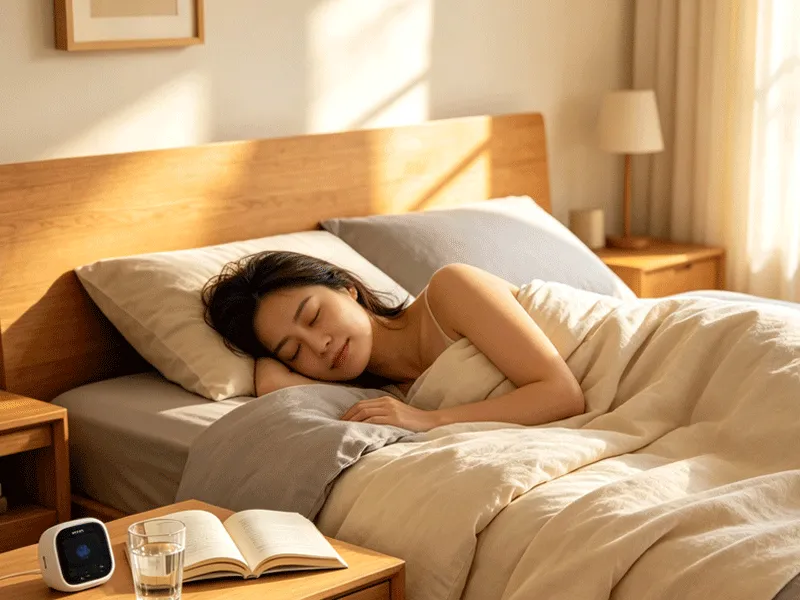
Sleep products are increasingly moving beyond the idea of simply making people feel sleepy. For many consumers, the challenge is winding down after a stressful day, quieting mental activity, and maintaining a sense of relaxation before bedtime.
This has increased interest in L-theanine, a naturally occurring amino acid found primarily in tea leaves. Known for its role in relaxation and stress management, L-theanine has also become an increasingly popular ingredient in sleep and wellness formulations.
But what does the research say about L-theanine and sleep, and where does it fit in a modern sleep formula?
L-theanine is a non-protein amino acid naturally found in the leaves of Camellia sinensis, the plant used to produce green, black, white, and other types of tea.
Unlike traditional sedative ingredients, L-theanine is primarily studied for its potential to promote a state of relaxation without necessarily causing daytime drowsiness. This makes it particularly interesting for products positioned around relaxation, stress management, focus, and sleep support.
Research has explored several possible mechanisms behind these effects, including interactions with neurotransmitter systems and changes in brain activity associated with relaxation. However, the exact mechanisms through which oral L-theanine may influence sleep are still being investigated.
For formulators, this distinction is important. L-theanine is not simply another “sleep-inducing” ingredient. Its potential value lies more broadly in supporting relaxation and reducing factors that may interfere with healthy sleep.
Human research on L-theanine and sleep has expanded considerably in recent years.
A 2025 systematic review and meta-analysis examined 19 articles involving 897 participants and found that L-theanine supplementation significantly improved several subjective sleep outcomes, including sleep onset latency, daytime dysfunction, and overall subjective sleep quality. The authors noted, however, that further research is needed to determine optimal dosage and duration, particularly for pure L-theanine supplementation.
A separate systematic review published in 2026 focused specifically on 13 trials in which L-theanine was used as a standalone intervention. Across these studies, doses ranged from 50 to 900 mg per day. The review reported potential benefits across several sleep-related measures, including sleep latency, sleep maintenance, sleep efficiency, sleep satisfaction, and feelings of refreshment after waking. The authors highlighted 200–450 mg/day as a range showing promising results in the available trials, while also calling for more high-quality research.
L-theanine has also been studied in relation to stress, which is particularly relevant to sleep formulation. A systematic review of randomized controlled trials found that supplementation in the range of 200–400 mg/day may help reduce stress and anxiety-related responses in people exposed to stressful conditions, although the authors emphasized the need for larger and longer-term studies.
More recent clinical research continues to explore this connection. In a 2024 randomized, double-blind, placebo-controlled study, 400 mg/day of L-theanine was administered to healthy adults with moderate stress for 28 days. The study reported improvements in perceived stress and several sleep- and cognitive-related measures, although not all sleep outcomes differed significantly between groups.
Taken together, the evidence is encouraging but not uniform. L-theanine appears particularly relevant to relaxation, sleep onset, and perceived sleep quality, while the magnitude of its effects can vary depending on dose, population, study design, and formulation.
Based on current research, L-theanine may be particularly relevant to formulations focused on:
Relaxation before bedtime
Stress management
Sleep onset support
Perceived sleep quality
Recovery and refreshed feeling after sleep
One of the more interesting aspects of L-theanine is that its positioning does not have to be limited to nighttime products. Its relaxation-oriented profile also creates opportunities for day-to-night wellness formulations, stress-support products, and products designed around mental relaxation without a strong sedative positioning.
For sleep products, this makes L-theanine a useful complementary ingredient rather than a standalone answer to every sleep concern.
The growing interest in L-theanine reflects a broader change in how brands approach sleep product development.
Instead of focusing only on whether a product helps someone fall asleep, formulators are increasingly considering the factors that influence the sleep experience before, during, and after bedtime.
This includes:
Stress and mental relaxation
Neurotransmitter balance
Sleep onset
Sleep maintenance
Overall sleep quality
L-theanine fits naturally into this broader framework because its research profile connects relaxation and stress management with sleep-related outcomes.
It can also be combined with other functional ingredients to create a more comprehensive formulation. For example, GABA and magnesium glycinate can contribute to the neurotransmitter-balance pathway, while melatonin is commonly used to support circadian rhythm.
This type of combination allows product developers to build around complementary functions rather than relying on a single ingredient.
This multi-pathway approach is also reflected in NF TriSolve® Sleep Health Solution.
Within the formulation, L-theanine works together with GABA and magnesium glycinate in Pathway 2 — Neurotransmitter Balance, supporting the relaxation and nervous-system component of the overall sleep system.
The three pathways are designed to address complementary aspects of sleep health:
Pathway 1 — Circadian Rhythm Support Melatonin
Pathway 2 — Neurotransmitter Balance GABA, L-theanine, and magnesium glycinate
Pathway 3 — Stress Adaptation Ashwagandha
Rather than positioning L-theanine as a standalone sleep ingredient, NF TriSolve® uses it as one component within a broader formulation strategy.
The formulation is further supported by Natural Field's co-loaded liposomal delivery technology, which co-encapsulates Ashwagandha and melatonin within a liposomal system.
For product developers, the key consideration is not simply whether an individual ingredient can support sleep, but how different ingredients can be combined to address different and complementary aspects of sleep health.
L-theanine has developed from a tea-derived amino acid into a widely explored functional ingredient for relaxation, stress support, and sleep-related formulations.
Current human research provides encouraging evidence for improvements in sleep onset and subjective sleep quality, while recent systematic reviews also highlight the need for further research into optimal dosage, duration, and formulation strategies.
For modern sleep products, L-theanine may therefore be most valuable not as a standalone “sleep ingredient,” but as part of a well-designed multi-pathway formulation.
That is the approach behind NF TriSolve® Sleep Health Solution—combining L-theanine with complementary functional ingredients and advanced delivery technology to support the development of next-generation sleep health products.
1. Bulman A, D'Cunha NM, Marx W, Turner M, McKune A, Naumovski N. The effects of L-theanine consumption on sleep outcomes: A systematic review and meta-analysis. Sleep Medicine Reviews. 2025;81:102076.
2. Cotter J, Caddick CE, Harper JL, Ebajemito JK. Examining the effect of L-theanine on sleep: a systematic review of dietary supplementation trials. Nutritional Neuroscience. 2026;29(2):224–238.
3. Williams JL, Everett JM, D'Cunha NM, et al. The Effects of Green Tea Amino Acid L-Theanine Consumption on the Ability to Manage Stress and Anxiety Levels: a Systematic Review. Plant Foods for Human Nutrition. 2020;75(1):12–23.
4. Moulin M, Crowley DC, Xiong L, et al. Safety and Efficacy of AlphaWave® L-Theanine Supplementation for 28 Days in Healthy Adults with Moderate Stress: A Randomized, Double-Blind, Placebo-Controlled Trial. Neurology and Therapy. 2024;13(4):1135–1153.
5. Payne ER, Aceves-Martins M, Dubost J, Greyling A, de Roos B. Effects of Tea (Camellia sinensis) or its Bioactive Compounds L-Theanine or L-Theanine plus Caffeine on Cognition, Sleep, and Mood in Healthy Participants: A Systematic Review and Meta-Analysis of Randomized Controlled Trials. Nutrition Reviews. 2025;83(10):1873–1891.

Professor and Ph.D. Supervisor, School of Pharmaceutical Sciences, Southern Medical University. Head of the Functional Ingredient R&D Center, Natural Field. Professor Chong Li is a distinguished researcher in the field of advanced drug delivery systems and pharmaceutical technology innovation.

 EN
EN
 es
es  jp
jp  ko
ko  fr
fr  de
de  it
it  ru
ru  pt
pt  th
th  ar
ar  ms
ms