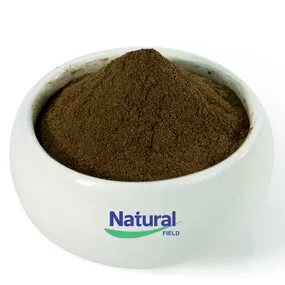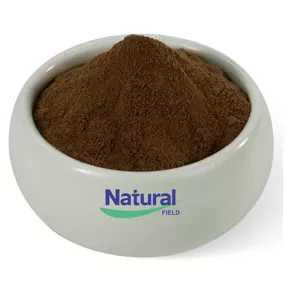

Abstract: In a high-quality study published in May 2025, a research team from the Department of Nutrition at the Naval Medical University of the People's Liberation Army designed a novel "screening system"—using a luciferase reporter model to "monitor" the activity of miR-122, akin to installing a "signal light" for miR-122. When a compound enhances miR-122 activity, the "signal light" brightens. Subsequently, they conducted large-scale high-throughput screening of 2,543 natural compounds, effectively searching for the "ideal partners" for miR-122.
After rigorous screening, dihydroberberine emerged as the standout candidate among 2,543 natural compounds: it not only significantly upregulates miR-122 levels but also exhibits no cellular toxicity—demonstrating both efficacy and safety.
In a high-iron-diet-induced mouse model of MASLD (Metabolic Dysfunction-Associated Steatotic Liver Disease), dihydroberberine demonstrated remarkable liver-protective effects:
Restores miR-122 Levels: Reverses iron-overload-induced reduction of miR-122, effectively reactivating the liver's "regulator".
Improves Lipid Metabolism: Reduces hepatic triglycerides and total fat content, leading to a visibly "cleaner" liver (evidenced by Oil Red O staining).
Prevents Oxidative Damage: Lowers levels of lipid peroxidation markers (e.g., MDA, LPO), protecting hepatocyte membranes from degradation.
Mitigates Liver Injury and Fibrosis: Significantly decreases ALT and AST (key liver injury markers) and alleviates hepatic fibrosis progression.
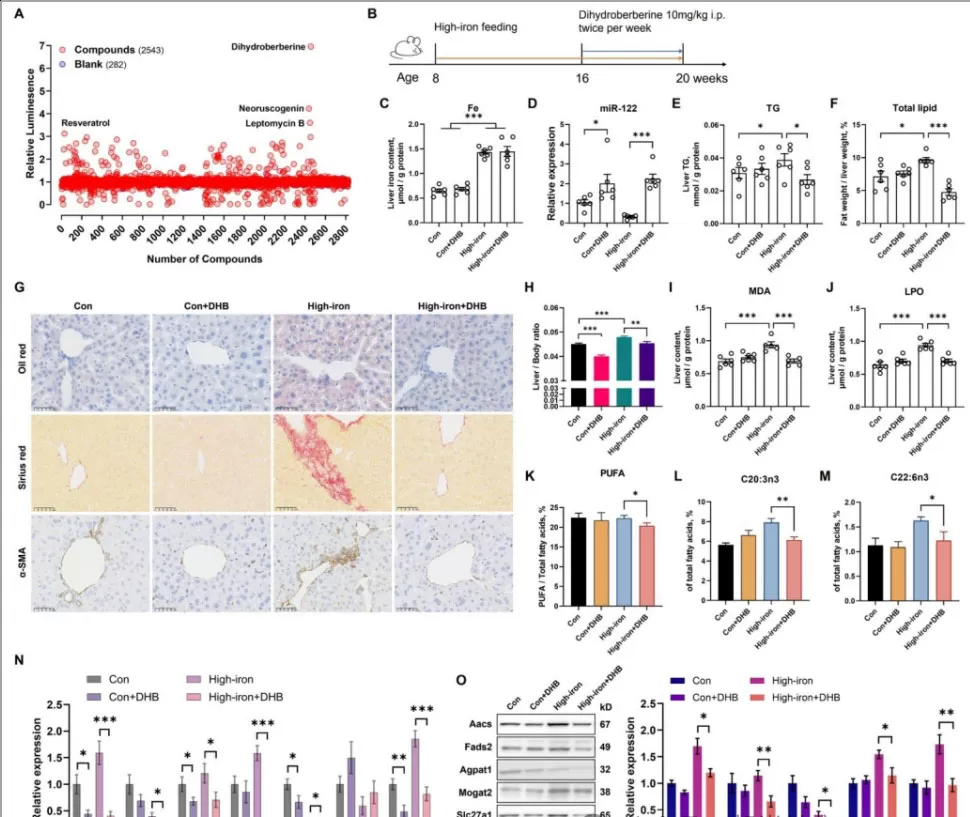
Figure D: miR-122 regulation – Iron overload caused a sharp decline in miR-122 expression, while DHB treatment restored it to near-normal levels.
Figures E-H: Lipid metabolism improvement – Iron overload induced hepatic triglyceride and total lipid accumulation, which were reduced following DHB administration.
Figures I-J: Oxidative damage mitigation – Iron overload increased oxidative products (MDA, LPO, etc.), while DHB treatment significantly decreased these markers.
Figures K-M: Fatty acid balance restoration – DHB treatment reversed iron overload-induced dysregulation of polyunsaturated fatty acids and restored beneficial fatty acid ratios.
Figures N-O: Protein regulation – Iron overload disrupted the expression of lipogenesis-related proteins, which was normalized by DHB intervention.
Among 2,543 compounds screened, dihydroberberine (DHB) stood out not by chance, but by demonstrating both the strongest miR-122 upregulation and perfect cellular biocompatibility—a critical foundation for clinical translation.
Iron overload damages the liver through a defined cascade:
Iron overload → miR-122 crash → dysregulated lipogenic proteins → lipid accumulation + oxidative stress → exacerbated liver disease.
DHB interrupts this vicious cycle by:
DHB supplementation → miR-122 recovery → suppressed lipogenic proteins → reduced lipid deposition + mitigated oxidative damage → hepatic "cooling down".
The study conclusively demonstrates that DHB:
Upregulates miR-122 to silence detrimental genes (e.g., Aacs, Fads2, CYPs) driving lipogenesis and oxidation
Fundamentally breaks the "iron overload → metabolic dysfunction" feedback loop
Offers dual action—metabolic regulation and hepatoprotection—for populations suffering from iron overload and MASLD
From elucidating how iron and miR-122 synergistically harm the liver, to identifying DHB through systematic screening, this research illuminates a promising therapeutic avenue for MASLD intervention.
References:
Yuxiao Tang 1, Zelong Gao et al. Breaking the synergism of iron overload and miR-122 to rescue lipid accumulation and peroxidation in MASLD. Pharmacol Res. 2025 May:215:107728.

Professor and Ph.D. Supervisor, School of Pharmaceutical Sciences, Southern Medical University. Head of the Functional Ingredient R&D Center, Natural Field. Professor Chong Li is a distinguished researcher in the field of advanced drug delivery systems and pharmaceutical technology innovation.

 EN
EN
 es
es  jp
jp  ko
ko  fr
fr  de
de  it
it  ru
ru  pt
pt  th
th  ar
ar  ms
ms